
Jace Baptista-Allan
Computer Science and Physics student at the University of Washington.
Born and raised in Seattle, I build VR physics simulations at UW. I build to understand, then build so others can understand too.
Why computer science and physics?
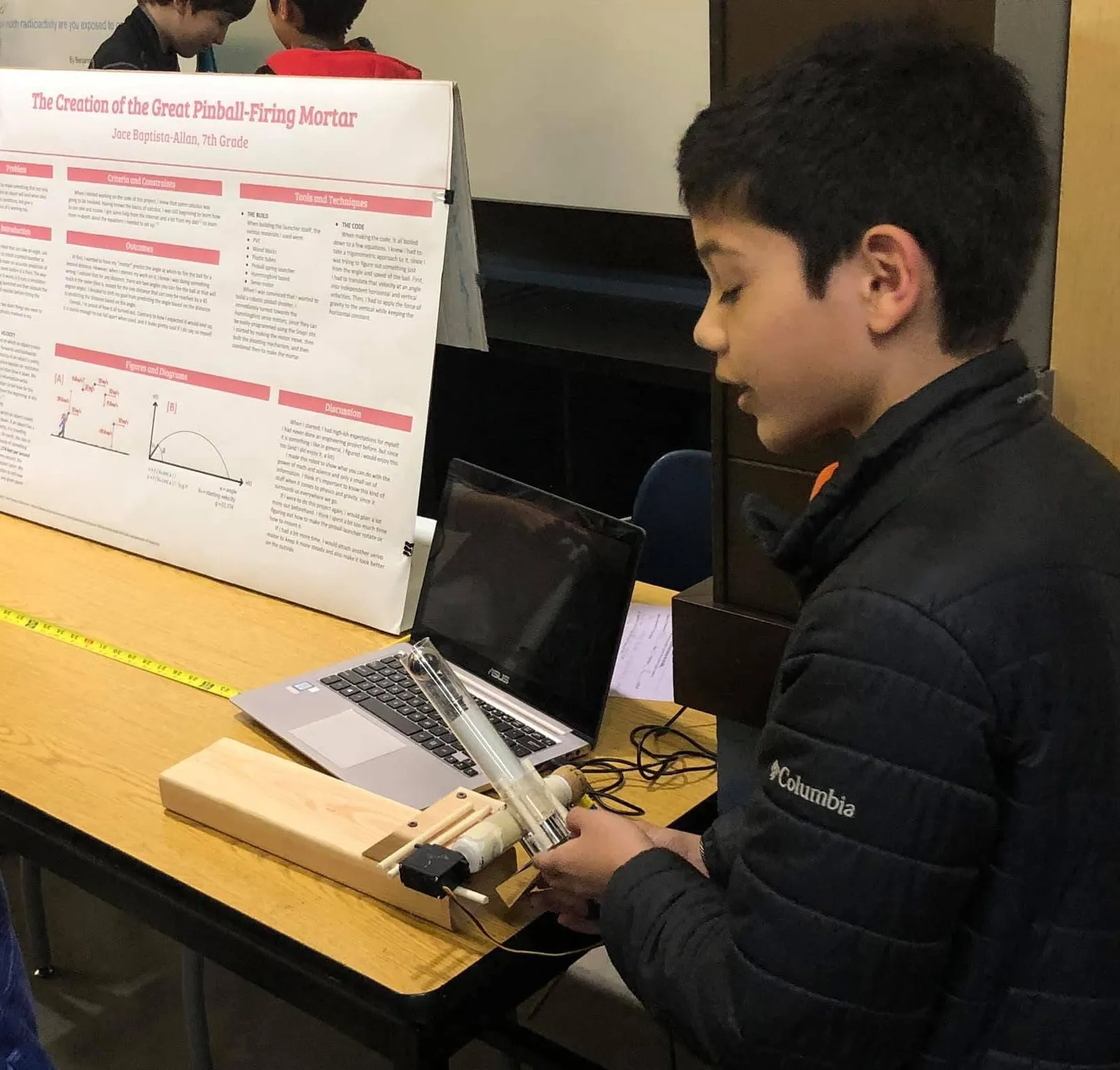
I fell in love with both a long time ago, during a middle school science fair project. Armed with an Arduino, servo motors, and a spring from a pinball machine, I constructed a pinball cannon and programmed a trajectory solver that adjusted the cannon's angle to shoot the pinball a target distance. Despite my improvised materials, it actually worked.
Physics asks you what’s true underneath a system, and computer science lets you turn that model into something other people can use. During my time tutoring physics and building labs for VR, I’ve seen how much the right tool changes what people can grasp.
How I work
I prefer being spec-first. When working in teams or with AI agents, I always start with the requirements and get everyone on the same page before anything gets built.
At NOMR, I focus on mathematical accuracy and on designing open-ended labs that let users set up their own experiment without following a deterministic lesson plan. Each week I consolidate research, meet with an expert, and set goals for the next sprint. I derive every formula on paper before it gets solidified into the code.
Right now
Software developer, Novel Observations in Mixed Reality
UW Department of Physics
See the VR physics labsOutside the lab
I’ve played drums since I was 7, and I’ve been making 3D animations since 7th grade (fun fact: when I was 14, I made a video intro for PewDiePie and he used it!). I also like building custom keyboards. Right now, I’m working on machining a keyboard case out of some walnut wood.
I also love making geometry puzzles. This was one of my favorites to make. See if you can solve it!
What fraction of the quarter circle is shaded?
The marked segments are congruent, and the small circle is tangent at the marked points.
Show the solution
The quarter circle has radius 1, each marked segment has length x, and the small circle has radius r.
Quote of the week
In the beginning the Universe was created. This has made a lot of people very angry and been widely regarded as a bad move.
Contact
- Roles
- Systems, ML and computer vision, simulation, software engineering
- Timing
- Spring or summer 2027 internships; full-time from June 2028
- Location
- Seattle; open to remote and relocation